
London Medical Cardiology
Chest pain
London Medical’s Cardiology Clinic provides the most up-to-date investigative cardiac procedures for patients with heart problems – and some of the UK’s most renowned cardiologists hold clinics here for all aspects of heart disease.
London Medical’s high class cardiology care to keep your heart healthy
Chest pain is a frightening symptom, however most chest pain is not caused by problems with your heart. Your lungs, ribs, muscles and digestive system can all cause pain and discomfort in your chest. London Medical’s cardiac physicians are experts in identifying, treating and preventing cardiovascular disease. If you are concerned about pain, London Medical offers the latest cutting-edge investigations for chest pain, so that treatment can be targeted to relieve your symptoms and safeguard your future health.
When chest pain is an emergency
Some chest pain cannot wait for a routine appointment and investigations. You should call 999 and get urgent care if you develop sudden pain in your chest that:
- Feels tight, heavy or crushing
- Continues for more than 15 minutes
- Spreads into the arms, neck, jaw or through to the back
- Is associated with breathlessness, clamminess or sweating
- Makes you feel unwell, weak or nauseous
You may be having a heart attack, which needs immediate emergency treatment.
A clot in the lung causes sharp chest pain that’s worse on breathing in. It may be linked to breathlessness and coughing up blood. A Pulmonary Embolism is a medical emergency and should also be treated urgently in hospital.
Investigation of chest pain at London Medical
London Medical state-of-the-art cardiology clinic offers the latest investigative procedures for patients with chest pain. Some of the UK’s most renowned cardiologists provide expert assessment and treatment, supported by a team of dedicated cardiac nurses, ultrasound specialists, and physiology technicians. Depending on your symptoms, your examination and your health investigations could include:
- ECG recording
- Treadmill exercise stress tests
- Echocardiography
- Ambulatory blood pressure monitoring using the latest technology
- Ambulatory ECG recorders
- 24 hour tape to look for cardiac arrhythmias
Assessment of your risk of developing heart disease
London Medical offers an in-depth assessment of your individual risk of developing heart disease. A range of non-invasive tests are available from London Medical’s laboratory and the state-of-the-art imaging suite. The results are used to identify risk factors and evaluate your current heart health. Tests include:
- Screening for diabetes
- BP monitoring
- Comprehensive cholesterol and lipid profile: London Medical provides cutting-edge
cholesterol and lipid testing to help assess your risk of cardiac disease. In addition to
traditional cholesterol testing, London Medial exclusively offers LDL particle number
analysis, one of the most powerful tools for predicting heart attack risk. - Carotid artery ultrasound: Scanning the carotid artery in the neck is an effective, low
radiation way of measuring the lining thickness and the size of any fatty plaques. A
coronary artery calcium score is also assessed and these results are used in
conjunction with the findings from the cholesterol blood tests to provide an overall
assessment of personal risk.
Our Consultants

Dr George Amin-Youssef
Consultant cardiologist who deals with adults and specialises in heart failure, including advanced heart failure, working in one of the largest heart failure units in the UK.

Professor Carlo Di Mario
Specialist in Interventional cardiology – the use of catheters and other devices to restore blood flow to the heart without major surgery.

Dr Claire Chalmers-Watson
Dr Chalmers-Watson is an experienced General Practitioner with over two decades of experience in primary care and a profound expertise in managing a broad spectrum of health conditions.

Professor Piers Daubeney
Professor Piers Daubeney is a consultant paediatrician at London Medical, specialising in paediatric cardiology.

Dr Shouvik Haldar
Consultant Cardiologist and Electrophysiologist at the Royal Brompton and Harefield Hospitals with a specialist interest in the management of patients with abnormal heart rhythms.
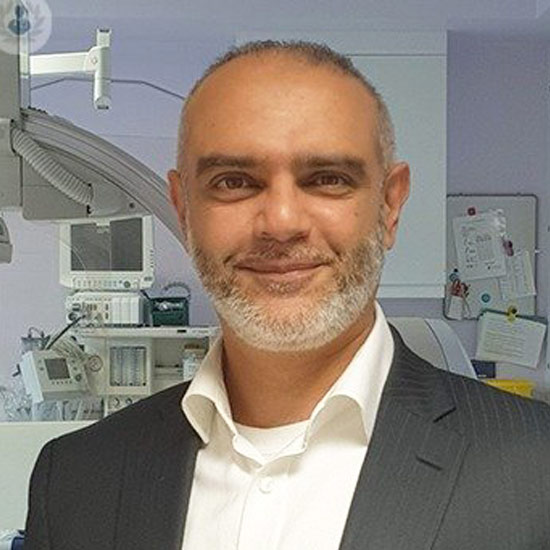
Dr Riyaz Kaba
Consultant cardiologist and electrophysiologist, specialising in arrhythmias, ablations, and pacemakers.

Professor Thomas F. Lüscher
Consultant in cardiology, interested in interventional cardiology, rhythmology, echocardiography, heart failure, acute cardiac care, and sports cardiology.

Dr Khaled Mallek
An esteemed consultant interventional and general cardiologist, specialising in complex coronary interventions and chronic total occlusions.

Dr Nikolaos Papageorgiou
Dr Nikolaos Papageorgiou is a consultant cardiologist at London Medical, specialising in heart failure and electrophysiology.

Professor Kausik Ray
Consultant preventative cardiologist, specialising in diabetes, lipids, glucose, hypertension and cardiometabolic traits.
Our Cardiology specialties
We offer care across a broad range of cardiology specialties. We have some of the top specialists in every aspect of cardiac care. Our entire team is dedicated to working together to consider the results of your investigations, your health and your lifestyle before tailoring a treatment plan to your individual needs.
Coronary artery disease (CAD) is a type of cardiovascular condition in which the vessels that supply blood to the heart become constricted by fatty deposits. The buildup of these fatty deposits is called atherosclerosis. CAD is commonly referred to as coronary heart disease, which is the most common form of heart disease
Symptoms
Conditions
Tests
Echocardiogram (inc. trans-thoracic and stress echo)
Cardiac MRI
Resting ECG
Treatments
Percutaneous coronary intervention
Heart failure is a long-term condition in which the heart is unable to pump blood throughout the body as it should. Your body depends on the heart to supply oxygen-rich and nutrient-rich blood to the body’s cells.
Symptoms
Breathlessness (when walking up hill/stairs/upon exercise)
Conditions
Heart failure
LV fibrosis
Tests
Echocardiogram (inc. trans-thoracic and stress echo)
Resting ECG
Treatments
Implantable cardioverter-defibrillator (ICD)
Cardiac Resyncronicization Therapy (CRT)
Your heart has four heart valves that control the flow of blood in one direction. If you have valvular heart disease, it means one or more of these valves are not working as they should. This can cause problems with your blood flow, putting extra strain on your heart to work harder.
Symptoms
Breathlessness (when walking up hill/stairs/upon exercise)
Conditions
Aortic/Heart valve disease/stenosis (inc. Mitral valve regurgitation)
Tests
Echocardiogram (inc. trans-thoracic and stress echo)
Resting ECG
Holter ECG
Exercise test
Treatments
TAVI
SAVR
Mitraclip
Valve replacement/reconstruction
Your heartbeat is controlled by electrical impulses. It’s normal for us to experience changes in our heartbeat at different times of the day depending on our activities. But if you have an arrhythmia, it means that the electrical activity that controls your heartbeat is affected.
Symptoms
Palpitations
Dizziness
Syncope
Conditions
Heart/AV Block
Tachycardia (inc. Ventricular Tachycardia (VT runs) and Superventricular tachycardia)
Bradycardia
Tests
Resting ECG
Holter ECG
Echocardiogram (inc. trans-thoracic and stress echo)
Treatments
Beta blockers
Cardioversion
Pacemaker
Anticoagulants
Cardiac ablation
ICD implantation
Blood pressure is the pressure of your blood pushing against your arteries. Your blood pressure naturally goes up and down throughout the day. Hypertension is the medical term for when your blood pressure numbers are consistently too high.
Symptoms
Unusual Hypertension
Renal artery stenosis
Endocrine hypertension
Ordinary hypertension
Tests
Echocardiogram (inc. trans-thoracic and stress echo)
24h Ambulatory Blood Pressure Monitoring
Treatments
Diet:
Low salt DASH diet
Drugs:
Calcium channel blockers
ACE-inhibitors
Beta blockers
Renal nerve ablation for severe resistant hypertension
Cholesterol is a fatty substance in our blood that is produced naturally in our liver. It is essential for your body’s normal functioning – it is used by our cells to make some hormones and vitamin D. Cholesterol can also be found in the foods we eat. Over time, if your blood cholesterol levels are too elevated, it can pose a serious risk to your health.
Symptoms
None
Conditions
Monogenic Familial hyperlipidaemia
Polygenic hyperlipidaemia
Dyslipidaemia (low HDL, high LDL, raised triglyceride)
Familial combined hyperlipidaemia
Rare lipid disorders
Tests
Advanced lipoproteins (NMR lipoproteins, oxidised LDL cholesterol, lipoprotein (a))
Coronary calcium score
Our Locations
London Medical is located in the Harley Street medical area. Together with top experts across a range of multi-disciplinary fields, we offer the finest facilities for your care, all under one roof.
Monday to Friday 8.30am to 8pm
Monday to Friday 8.30am to 8pm
Monday to Friday 8.30am to 8pm
Speak to a member of our team

Get in touch
If you have any questions or want to book an appointment, please speak to our team on +44 (0)800 0483 330.
Or, make an enquiry online using this form and one of our team will be in touch. Please note, all the information collected is required as part of our registration process. By using this form you agree with the storage and handling of your data by our team. You don't need a referral from your GP to make an appointment with us.
Contact us
Our team can also be contacted on +44 (0)800 0483 330.
Please note, all the information collected is required as part of our registration process. By using this form, you agree with the storage and handling of your data by our team.
Heart Health News
Find out the latest news, thinking and insights from our experts. Our Heart Health News is your go-to source of trusted advice and knowledge on all matters of the heart.

Chest pain and how it may be avoided

6 ways to prevent heart disease

LDL cholesterol – one size does not fit all…
Reviewed by